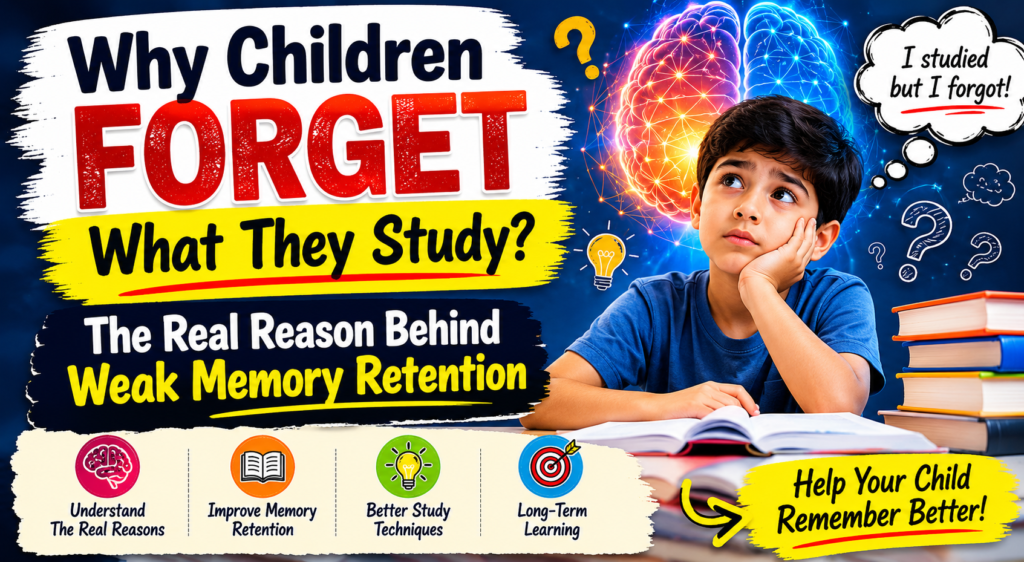
Why Children Forget What They Study: The Real Reason Behind Weak Memory Retention
Many parents feel worried when their child studies sincerely but forgets everything during revision, class tests, or exams. The child reads the chapter, understands it for the moment, even says, “Yes, I remember it,” but after a few hours or days, the same answer disappears from memory.
This does not always mean the child is careless, weak, or less intelligent.
In most cases, children forget what they study because the information never reaches strong long-term memory. It stays only in short-term memory for a while and fades away when it is not revised, recalled, connected, or understood properly.
Memory is not created by simply reading a page again and again. Real memory is created when the brain understands, connects, recalls, and uses the information repeatedly over time.
Research on learning shows that spacing study sessions over time and retrieval practice, which means trying to recall information without looking at the book, are powerful methods for improving long-term retention.
So, the real question is not only, “Why is my child forgetting?”
The better question is, “Is my child studying in a way that helps the brain remember?”
What Is Memory Retention?
Memory retention means the ability to store learned information and recall it later when needed.
For example, if a child learns 20 vocabulary words today and can remember them after one week, that is good memory retention. But if the child remembers them only for a few minutes and forgets them the next day, the learning is weak.
Memory retention depends on three major steps:
Encoding – how the information enters the brain
Storage – how the brain keeps the information
Retrieval – how easily the child can recall it later
If any of these steps are weak, the child may forget quickly.
A common mistake is that many students focus only on the first step: reading. But reading alone does not guarantee remembering. The brain must also organize and recall the information.
The Real Reason Children Forget What They Study
The biggest reason children forget is not lack of intelligence. It is usually passive learning.
Passive learning means the child is looking at the book, reading the lines, highlighting notes, or listening to the teacher, but the brain is not actively working with the information.
The child may feel that they have learned something because the content looks familiar. But familiarity is not the same as memory.
For example, when a child reads an answer five times, they may feel, “I know this.” But when the book is closed and they are asked to explain it, they struggle. This happens because the child has recognized the answer, but has not practiced recalling it.
This is why many children say:
“I studied everything, but I forgot in the exam.”
Actually, they did not forget everything. They studied in a way that made the content familiar, not retrievable.
1. Children Forget Because They Only Read They Don’t Recall
One reason why children have trouble remembering things is that they just read something over and over without trying to remember it on their own.
A lot of kids think that if they read the thing many times they will remember it.. Our brain actually remembers things better when we have to think really hard to recall them without looking at the book.
This is called retrieval practice. Retrieval practice is when you close your book and ask yourself some questions. Children should ask themselves:
“What did I just learn about this thing called retrieval practice?”
“Can I explain this thing called retrieval practice in my words?”
“Can I write the answer without seeing the book that teaches me about retrieval practice?”
“Can I teach this thing called retrieval practice to someone else like my friend or family member who wants to learn about retrieval practice?”
There have been studies and educational research that explain why retrieval practice is helpful. These studies and educational research on retrieval practice say that retrieval practice helps us learn things better in the run because our brain gets practice remembering things from memory when we use retrieval practice.
Better Method
of saying to the child “Read this chapter about retrieval practice again” we should ask the child:
“Close the book that teaches you about retrieval practice and tell me what you remember about retrieval practice.”
This simple thing can actually help children remember things better than reading the thing over and over, about retrieval practice.
2. Children Forget Because They Try to Study Everything at Once
Another reason children forget things is that they cram all their studying into one session.
Cramming is when you study a lot of things all at once right before a test or exam.
The child might remember some of it for a while but after a short time they forget most of it.
Our brain does not like it when we try to learn much at the same time.
When you try to learn many things at once the child can feel tired, confused and stressed out.
Children who study like this may feel overwhelmed.
A better way for children to study is to use something called repetition.
Spaced repetition means that you go over the topic again and again but with breaks in between.
For example:
- Day 1: You learn about the topic
- Day 2: You do a review
- Day 4: You try to remember it
- Day 7: You test yourself to see if you really know it
- Day 15: You do one review
This way of studying really works because it helps children remember things better when they learn a little bit at a time.
This is called the spacing effect.
Better Method
of studying for 3 hours all in one day it is better to study for shorter times over several days.
This is especially good, for children because they can only focus for a time and they get tired easily.
Children have limited attention span and mental energy spaced repetition is a great way for them to study.
3. Children Forget Because They Do Not Understand the Meaning
Children often forget what they study when they try to memorize things without understanding what these things mean.
This happens a lot in subjects like vocabulary and grammar and science definitions and history answers and social science points.
For example if a child memorizes the word “generous” as “kind” they may forget the word “generous” soon.
If they understand what the word “generous” means through an example. “A person who is generous shares food, time, money or help with others”. The word “generous” becomes meaningful to them.
The brain remembers meaning better than information.
This is why storytelling and examples and visuals and real-life connections make learning stronger.
When the child can connect a concept like the word “generous” with an image or a story or an action or an emotion memory becomes deeper.
Better Method
Do not ask only “Have you memorized the word or the concept or the information?”
Ask the child these questions:
- What does the word or the concept or the information mean?
- Can you give an example of the word or the concept or the information?
- Where can we use the word or the concept or the information, in life?
- Can you make a sentence with the word or the concept or the information?
Understanding the word or the concept or the information creates memory.
Rote learning creates storage of the word or the concept or the information.
4. Children Forget Because They Do Not Revise at the Right Time
A lot of students only revise when their exam is coming up. This is a mistake that children make.
Children should revise regularly.
Forgetting starts happening fast after we learn something new if we do not go over it again. The forgetting curve is a thing that explains how the things we learn can be forgotten quickly if we do not remind ourselves about them.
The problem is not that the child is not able to remember things. The problem is that children revise late.
Children need to revise at the time so they do not forget what they learned.
If a child learns something today and then revises it after twenty days their brain is going to treat it like new information all over again.
This means the child will have to learn it over again.
Children should revise what they learned so they do not forget about the things they learned.
Better Method
We should use revision within twenty four hours.
A simple way to revise can be like this:
revision: On the day that the child learned something new
Second revision: On the next day
Third revision: After three days
Fourth revision: After one week
Fifth revision: Before the test
This does not take a long time.
Ten to fifteen minutes of going over what the child learned can make a big difference, in what they remember.
Children can do this. It will really help them to remember the things they learned.
Revision is very important for children to remember what they learned about the things they are studying.
5. Kids Forget Because They Study Without Focus
kids sit with books for a long time. They can’t keep their minds on the books.
They might study while checking their phones watching TV chatting with friends or thinking about games. When they do this their brains don’t really learn the information.
Attention helps us remember things. If kids aren’t paying attention they won’t remember things well.
A kid might sit with a book for two hours. Only pay attention for 20 minutes.
That’s why parents shouldn’t judge if their kids are studying by how much time they sit with a book. Sitting with a book doesn’t mean they are learning.
Better Way
Try focused study sessions:
25 minutes of study
5 minutes of break
25 minutes of study
quick recall
For little kids even 15-20 minute focused sessions can work better, than long tiring study sessions.
How to Improve Memory Retention in Children
Now that we understand why children forget lets talk about what parents and teachers can do to help.
1. Use Active Recall
After every study session ask the child to close their book and tell you about the topic they just learned.
You can do this by:
- Asking them questions out
- Giving them a written test
- Using flashcards
- Having them teach someone
- Creating a mind map
- Quizzing themselves
Active recall helps make their brain stronger.
2. Use Spaced Revision
Don’t wait for exams to revise what they’ve learned.
Instead revise the topic after a gap like:
- On the day
- The next day
- After 3 days
- After 7 days
- After 15 days
This helps move what they’ve learned into their long-term memory.
3. Connect Learning With Stories
Stories are powerful because they create pictures in their mind.
For vocabulary, grammar and concepts storytelling can make learning more memorable.
For example children remember a word when its connected to:
- A character they like
- A funny image
- A real-life scene
- A short story
- An emotional moment
This is why story-based learning can be really helpful for students who forget words and concepts quickly.
4. Make the Child Explain in Their Words
If a child can explain something simply they really understand it.
Ask them to:
“Explain this like you’re teaching your brother or sister.”
This helps improve their understanding. Shows you where they might need more help.
5. Avoid Long Boring Study Sessions
Long study sessions can make them lose focus.
Try sessions with breaks instead.
For example:
- 20-25 minutes of studying
- 5 minutes of break
- 5 minutes of recalling what they learned
This keeps their brain active and engaged.
6. Practice Before Exams Not Just Read
Before exams children shouldn’t just read their notes. They should practice recalling and writing answers.
Exam memory gets better when they practice recalling answers like they will in the exam.
You can use:
- Sample papers
- Oral tests
- Written answers
- Quick quizzes
- questions
- Timed practice
Practicing creates confidence.
7. Create a Positive Learning Environment
Children remember better when they feel safe, supported and confident.
Don’t constantly compare them to children.
Of comparing focus on how much they’ve progressed.
Say:
“Yesterday you remembered 5 words. Today you remembered 8. That’s an improvement.”
Positive feedback builds confidence, in learning.
A Simple Memory Formula for Students
Here is an easy formula kids can follow:
Understand → Connect → Recall → Revise → Use
First you gotta understand the topic.
It’s like get it in your head.
Then connect it with examples or stories.
That makes it more fun and easy to remember.
Then try to recall it without looking.
See if you can remember it on your own.
Then revise it at times.
Don’t try to cram it all in one go.
Then use it when you’re writing, talking or solving problems.
That helps make it stick.
This formula can help you remember anything in school.
Kids Don’t Forget Because They Are
Kids forget what they study not because their brain is weak but because their learning method is often weak.
I mean it’s not that they’re not smart.
Reading again. Again is not enough.
Real learning happens when you understand, recall, revise, connect and use the information.
If parents and teachers want kids to remember better they gotta change the way they study.
Make it more active.
The goal should not be:
“Study more.”
The goal should be:
“Study in a way your brain can remember.”
With the method even kids who forget easily can get a strong memory feel more confident and do better in school.
FAQs
1. Why does my child forget after studying?
Your kid might forget because they’re just reading and not trying to remember.
Information fades away if you don’t revise it.
2. How can I improve my child’s memory retention?
Try recall, spaced repetition, storytelling, visual examples, short study sessions and regular revision.
These things can really help.
3. Is forgetting a sign of intelligence?
No it’s not.
Forgetting is normal.
It just means the kid needs a way to learn.
4. What is the best revision method for children?
The best way is to revise with recall.
The kid should try to remember without looking at the book.
5. Why does my child remember games. Forget studies?
Games are fun, visual and interactive.
Studies can feel boring and passive.
If learning is made fun and active memory gets better.
6. How times should a child revise a topic?
A kid should revise a topic at 4–5 times: same day next day after 3 days after 1 week and before the test.
7. Does storytelling help children remember better?
Yes it does.
Storytelling creates pictures, in your mind. Makes you feel something.
That makes it easier to remember.
8. What is active recall?
Active recall means trying to remember information without looking at the book.
You can do it by asking questions taking quizzes writing or explaining it loud.